Case Study - Architecting Testable Cloudflare Workers for Adobe EDS

The Author Experience - From Metadata to SEO Gold
Adobe Edge Delivery Services (EDS) provides a fast foundation for websites. Real-world requirements often need custom edge logic - whether for SEO enhancement, security headers, or API integration.
The Problem Authors Face: Search engines and AI prefer structured data (e.g., JSON-LD) to interpret your content. Manually creating it is error-prone and time-consuming. Miss a field, get the syntax wrong, or forget to update it when content changes - and your SEO suffers.
The Solution: A Cloudflare Worker that transforms simple metadata into correct JSON-LD automatically.
For Authors, It's This Simple:
Add to your document metadata:
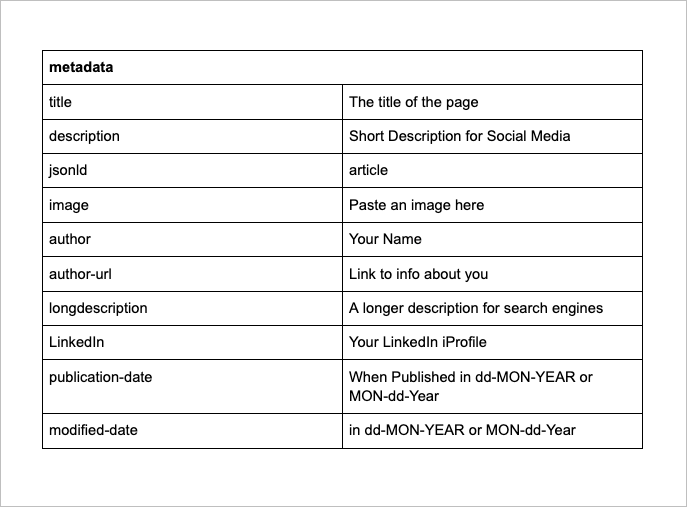
modified-date is optional, as is longdescription, author-url, and linkedIn
Pro Tip: longdescription provides for SEO-optimised content:
The worker uses longdescription (if present) for JSON-LD, while keeping og:description shorter for social media. This gives you separate control over search engine and social media descriptions.
Publish. Done.
The worker automatically generates valid JSON-LD:
{

  "@context": "https://schema.org",

  "@type": "Article",
  "headline": "Your Article Title",
  "description": "Detailed 2-3 sentence description for search engines",
  "author": {
    "@type": "Person",
    "name": "Your Name",
    "url": "https://yourwebsite.com"
  },
  "datePublished": "2025-12-09",
  "publisher": {
    "@type": "Organization",
    "name": "yourdomain.com"
  }
}
Smart Description Handling: The worker prioritises longdescription → og:description → omit if neither exists. Your social media cards still use og:description, while search engines get the more detailed version.
Intelligent Date Formatting: Enter dates however you like - UK format (10/12/2025), month names (10 December 2025, Dec 10 2025), or ISO format. The worker automatically converts them to a search engine-friendly format.
Author URL Fallback: If you don't provide an author-url, the worker automatically uses your LinkedIn profile for structured data, whilst keeping it for social media cards, using the LinkedIn metadata.
No JSON syntax to learn. No schema.org documentation to read. No manual updates when content changes.
The worker reads your existing metadata and automatically generates schema.org compliant structured data. Authors focus on content; the worker handles the SEO plumbing.
The Technical Challenge
We needed to build a worker to handle CORS headers, JSON-LD generation, and Metadata cleanup. The architecture needed to be:
- Author-friendly: Simple metadata trigger, no technical knowledge required
- Production-ready: Handles edge cases, errors, and validates correctly
- Testable: Thorough test coverage without complex infrastructure
- Operationally simple: Deploy via Dashboard, no CLI tooling required
The Metadata-to-JSON Pipeline: The worker reads standard EDS metadata fields and automatically maps them to schema.org objects. This ensures search engines receive properly structured data without manual authoring errors or JSON syntax issues.
This document outlines the architectural pattern we developed: "Two-File Simplicity".
The Architecture Pattern
The core philosophy of this pattern is strict separation of concerns between Business Logic and the Cloudflare Runtime.
The Pure Core - Business Logic
Most Worker tutorials encourage writing logic directly inside the fetch event listener. This makes testing difficult because you have to mock the entire Request/Response cycle just to test a string parsing function.
Instead, we extract logic into Pure Functions that know nothing about Cloudflare.
Pattern:
// Pure Function
// Input: Data Object. Output: Data Object.
// No dependency on 'Request', 'Response', or 'HTMLRewriter'.
export const buildJsonLd = (articleData, hostname) => {
  if (!articleData.title) return null;
  return {
    '@context': 'https://schema.org',
    '@type': 'Article',
    headline: articleData.title,
    publisher: {
      '@type': 'Organization',
      name: hostname
    }
  };
};
By keeping these functions pure, we can write Unit Tests that run in milliseconds without any test harness overhead.
The Thin Shell - Runtime Integration
The fetch handler acts only as a router and orchestrator. It parses the incoming request, calls the pure functions, and applies the results using the Cloudflare HTMLRewriter.
We also extracted specific HTMLRewriter handlers into standalone functions.
Pattern:
// Testable Handler
// Input: DOM Element Mock. Output: Side effects on the element.

export const handleViewport = (element, state) => {
  if (state.shouldGenerateJsonLd) {
    element.after('<script>...</script>', { html: true });
  }
};
The Testing Strategy
With logic extracted, we adopted a unified Unit + Integration testing strategy, contained in a single test file.
Layer A - Unit Tests (The "Micro" View)
We import the pure functions and handlers directly. We don't verify if Cloudflare works; we verify if our logic works.
- Does
buildJsonLdhandle missing titles per requirements? - Does
handleViewportinsert the script tag when the flag is set? - Does
getExtensioncorrectly parse.tar.gzfiles?
These tests are fast, deterministic, and cover 90% of the cognitive complexity.
Layer B - Mocked Integration Tests (The "Macro" View)
To ensure the pieces fit together, we use a lightweight Mock HTMLRewriter. We don't need a full browser or a local Wrangler instance for this. We simply verify the wiring.
The Mock:
class MockHTMLRewriter {
  on(selector, handler) {
    this.activeHandlers.push({ selector, handler }); // Record registration
    return this;
  }
  transform(response) { return response; } // Pass-through
}
The Test:
test('Request triggers correct handlers', async () => {
  // Simulate a request
  await worker.fetch(mockRequest, mockEnv);
  // Verify that the worker registered a handler for the viewport meta tag
  const hasHandler = MockHTMLRewriter.activeHandlers.some(h => h.selector === 'meta[name="viewport"]');
  expect(hasHandler).toBe(true);
});
This confirms that when a request arrives, the logic will be applied without the overhead of spinning up a server.
Handling Edge-Specifics - Port Redirects
A standard production requirement is normalising traffic. Cloudflare Workers often respond on non-standard ports internally. We implemented logic to redirect these:
if (url.port) {
  // Redirect to clean URL (no port)
  return Response.redirect(cleanUrl, 301);
}
In a traditional "spin up a server" test strategy, this blocks local testing because local dev servers always use ports (e.g., localhost:8787). Our mock-based strategy completely sidelines this issue. We test the logic that runs the redirect, but our test runner doesn't get caught in the redirect loop.
Why This Matters
This pattern delivers significant benefits for both authors and engineering teams.
For Content Authors
- Simple SEO: Add
| jsonld | article |to metadata, publish, done - Zero JSON Knowledge Required: Never write or debug JSON-LD syntax
- Always Current: JSON-LD regenerates from the latest metadata on every publish
- Error-Free: Worker validates and handles edge cases automatically
- Search Engine Ready: Valid schema.org compliance without technical expertise
For Engineering Teams
- Zero "It Works on My Machine": Tests run against compiled logic, not environmental side-effects
- Maintenance-Free: Test suite doesn't rely on fragile E2E setups or specific port bindings
- High Velocity: Refactor core logic with confidence - unit tests cover rules, integration tests cover delivery
- Production Safety: automated tests ensure correctness before deployment
- Simple Operations: Deploy via Dashboard, copy/paste, no CLI tooling required
The Business Impact
Author Productivity: What used to take minutes per article (researching JSON-LD syntax, creating structured data, validating) now takes seconds (adding metadata).
SEO Quality: Consistent, error-free structured data across all articles. Search engines get valid schema.org objects every time.
Operational Simplicity: One worker file, passing tests, Dashboard deployment. No build pipeline, no CLI tools, no deployment complexity.
By adopting this "Two-File" architecture (One Logic File, One Test File), we turned what is often a fragile, opaque part of the stack into the most reliable component of the system - while making life much easier for content authors.
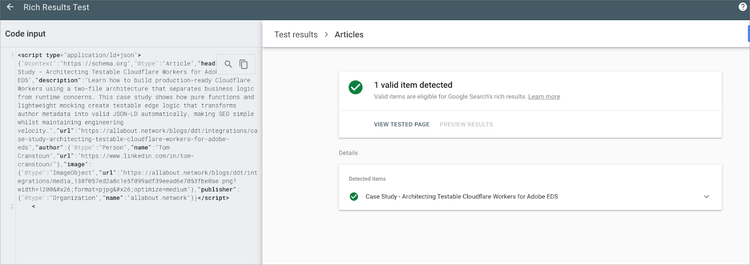
Proof of the pudding, this page’s metadata in json-ld
Related Articles