Is the CMS a Destination or a Workflow?

For decades, the CMS was defined by its ability to store and structure data. But as the pace of digital business accelerates, the definition is shifting. It is moving away from being a destination where content is "managed" and toward a service that enables content to "flow."
From Repositories to Workflows
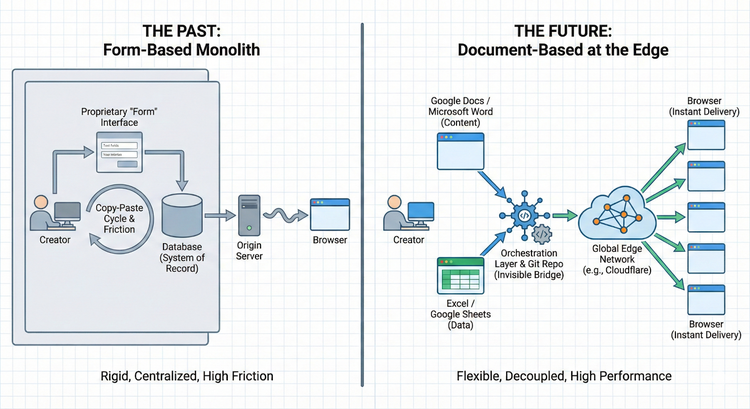
The content management landscape is undergoing a fundamental shift. This transition is about a complete re-imagining of the relationship between the creator, the system, and the end user.
The "Form-Based" Monolith
For twenty-five years, the industry standard has been Structured Authoring. In this model, the CMS is a centralised hub with its own proprietary interface.
- The Model: To add content to a website, log in to a specific dashboard, locate a text box, and enter your data.
- The Challenge: This often creates a "workflow gap." Content creators-who live in Google Docs or Microsoft Word - find themselves handing off work to editors who then manually "translate" that work into the CMS. This duplication of effort often leads to versioning issues and delayed time-to-market.
The Modern Shift: Document-Based Authoring
Newer architectures, such as those utilised by Adobe Edge Delivery Services (EDS) and Pantheon, are flipping the script. Instead of forcing creators into a proprietary dashboard, the "system" integrates directly into the tools they already use every day: Google Docs, Sheets, Microsoft Word, and Excel.
- Google Docs & Microsoft Word serve as the interface for long-form content and storytelling.
- Google Sheets & Microsoft Excel: These act as the "database" for structured data, pricing tables, or directory listings.
In this model, the "System" is the intelligent engine that sits between these documents and the web, transforming familiar files into high-performance, SEO-optimised digital experiences.
Defining the Modern CMS
To navigate this transition, we must look past the interface and focus on the output.
Technical Note: Under the Hood of Composable Content Architectures
The power of this "invisible CMS" model lies in its underlying architecture. When a creator hits "save" in Microsoft SharePoint or Google Drive, the system doesn't just display a doc. This pattern is used by many systems, including Edge Delivery Services (EDS) and systems like Pantheon, which use WordPress as a delivery platform.
- Conversion: The system pulls the source (docx or gdoc) and converts it into semantic, clean HTML or Markdown.
- Structured Data: For Excel or Google Sheets, the system transforms rows and columns into highly optimised endpoints that can power everything from pricing tables to complex applications.
- The Pipeline: Code is decoupled from content. This allows developers to push updates without touching the content, and vice versa.
- Edge Distribution: The final output is cached and delivered via high-performance edge networks (such as Cloudflare or Adobe's Edge Network), ensuring the site is blazingly fast regardless of the authoring source.
The Future
The tension between "traditional" and "modern" definitions of a CMS is progress. We are moving toward a world where the power of enterprise-grade governance meets the simplicity of a blank document.
The best CMS is no longer the one with the most features in its dashboard; it is the one that stays out of the way of the creative process while delivering the fastest, most reliable experience to the end user.
Traditional Content Management Systems (CMS) are nearing their end, with sophisticated AI agents poised to replace them. The older paradigm, in which a CMS serves as a central hub for content creation, storage, and publication, is becoming increasingly inefficient and outdated.
The shift is already underway, evidenced by the ubiquitous integration of AI into our daily content workflows. Today, content creators, including me, routinely use advanced large language models (LLMs) like Claude to assist with various stages of content production, such as outlining, drafting, and refining blog posts and articles. This is not just about novelty; it's about a fundamental transformation in productivity. Even the most basic tools, such as Grammarly's grammar and spell-check aids, serve as an entry point into this AI-assisted content future.
The progression from simple AI aids to fully autonomous AI agents signifies the next major leap. These agents will move beyond merely assisting; they will take over the end-to-end content lifecycle. Instead of logging into a static CMS interface, content creators will simply interact with an AI agent that handles all the heavy lifting: identifying content gaps, generating drafts based on strategic objectives, optimising for SEO and audience engagement, managing multi-channel publishing, and even automatically iterating on content performance. The human-in-the-loop must still be there, curating content and messages that AI cannot understand; it's the unwieldy infrastructure that disappears. Scary for some, I know.
Therefore, the critical question for the future is whether the function of "content management" will remain a discrete destination—a platform you navigate to—or dissolve entirely, becoming a seamless workflow—an invisible layer of intelligence integrated across all digital touchpoints. The momentum suggests the latter: AI agents effectively abstract away the complexities of the CMS interface, transforming content creation from a destination-based task into an integrated, intelligent, and autonomous workflow.
Tom Cranstoun has built web experiences for 25 years, from early e-commerce platforms to modern progressive web apps. He is writing a book, "The Invisible Users", https://allabout.network/invisible-users/book.html which synthesises two years of research into how AI agents interact with websites and the patterns that work for both agents and humans.
Related Articles